The Industrial City
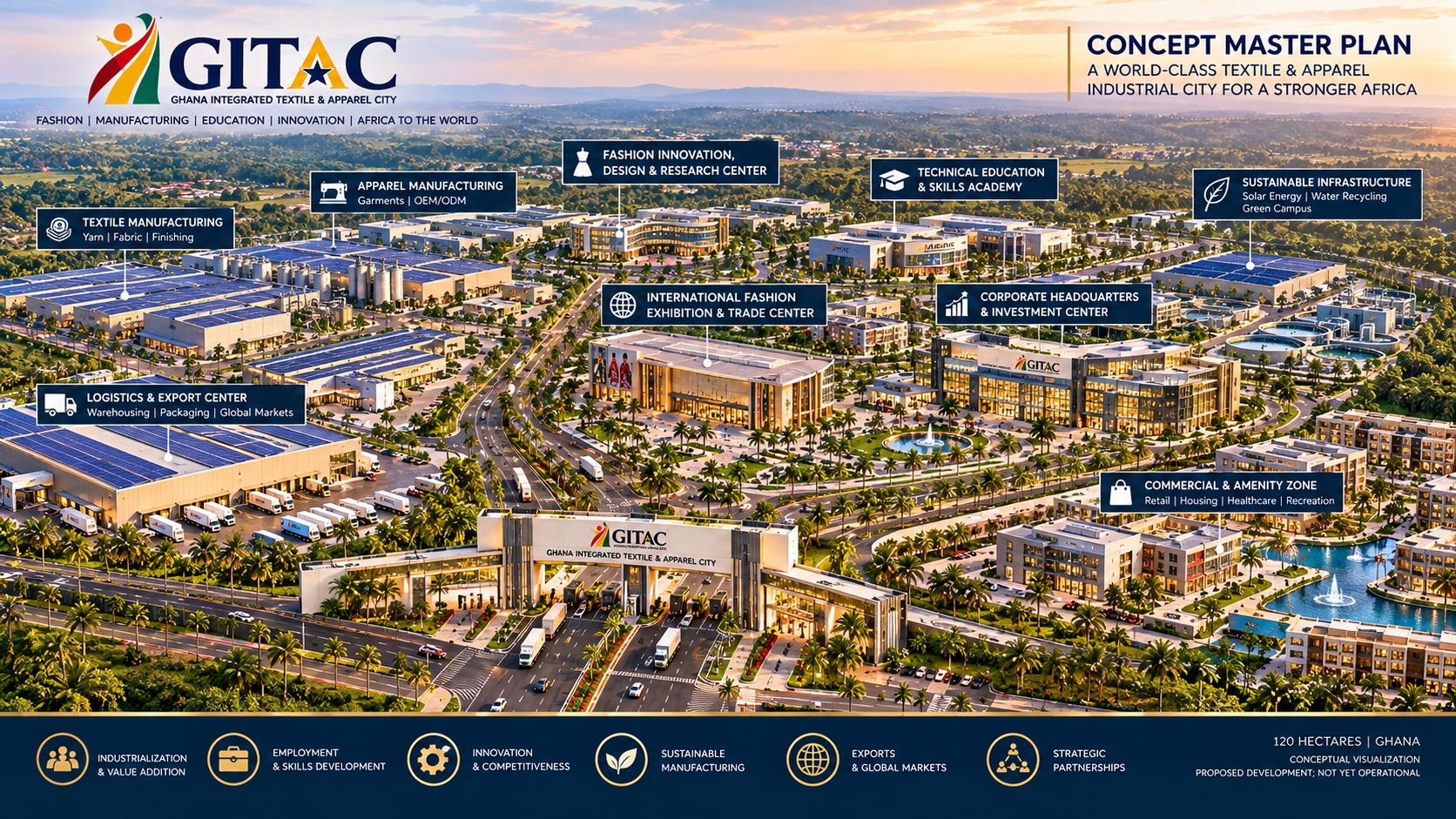
Ghana Integrated Textile & Apparel City (GITAC) envisions a modern industrial ecosystem integrating raw material processing, spinning, weaving, knitting, dyeing, garment manufacturing, fashion innovation, technical education, and international trade.
The proposed development will be designed to accommodate domestic and international manufacturers through phased industrial infrastructure, shared facilities, and strategic partnerships.
GITAC's preliminary planning concept covers approximately 400 acres, subject to feasibility studies, site selection, environmental assessment, and detailed master planning.
A Full Textile-to-Fashion Industrial Ecosystem
Illustrative concept master plan — proposed development, not yet operational. Land allocations and facility designs are preliminary.
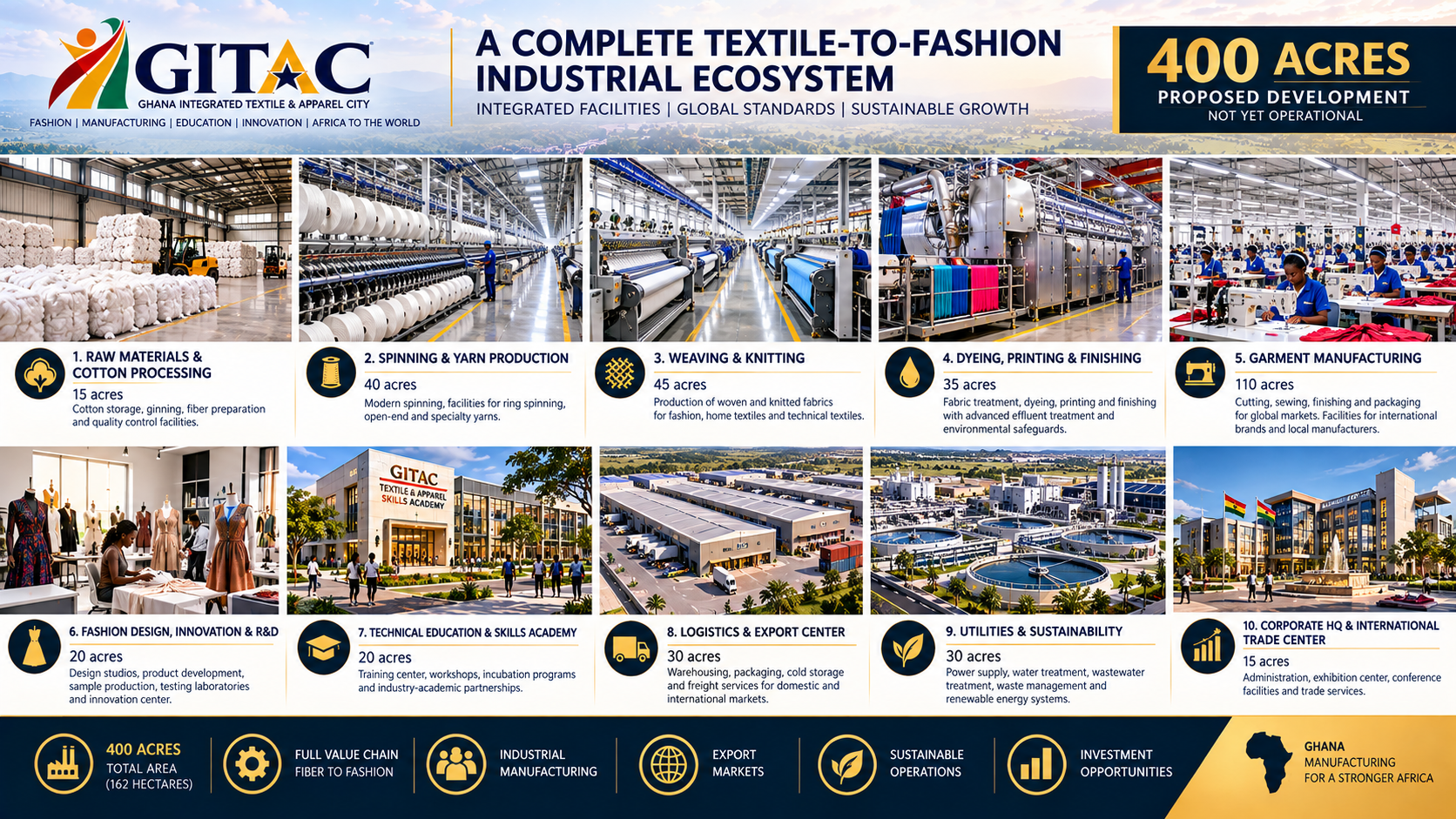
GITAC — Complete Textile-to-Fashion Industrial Ecosystem
GITAC is envisioned as an integrated textile and apparel manufacturing ecosystem, designed to accommodate the complete production value chain.
The proposed industrial city will combine textile processing, yarn production, weaving, knitting, dyeing, garment manufacturing, fashion innovation, technical education, and export logistics within a coordinated development.
By bringing manufacturers, training institutions, technology providers, and international partners together, GITAC aims to strengthen Ghana's industrial capabilities and create opportunities for sustainable manufacturing and global trade.
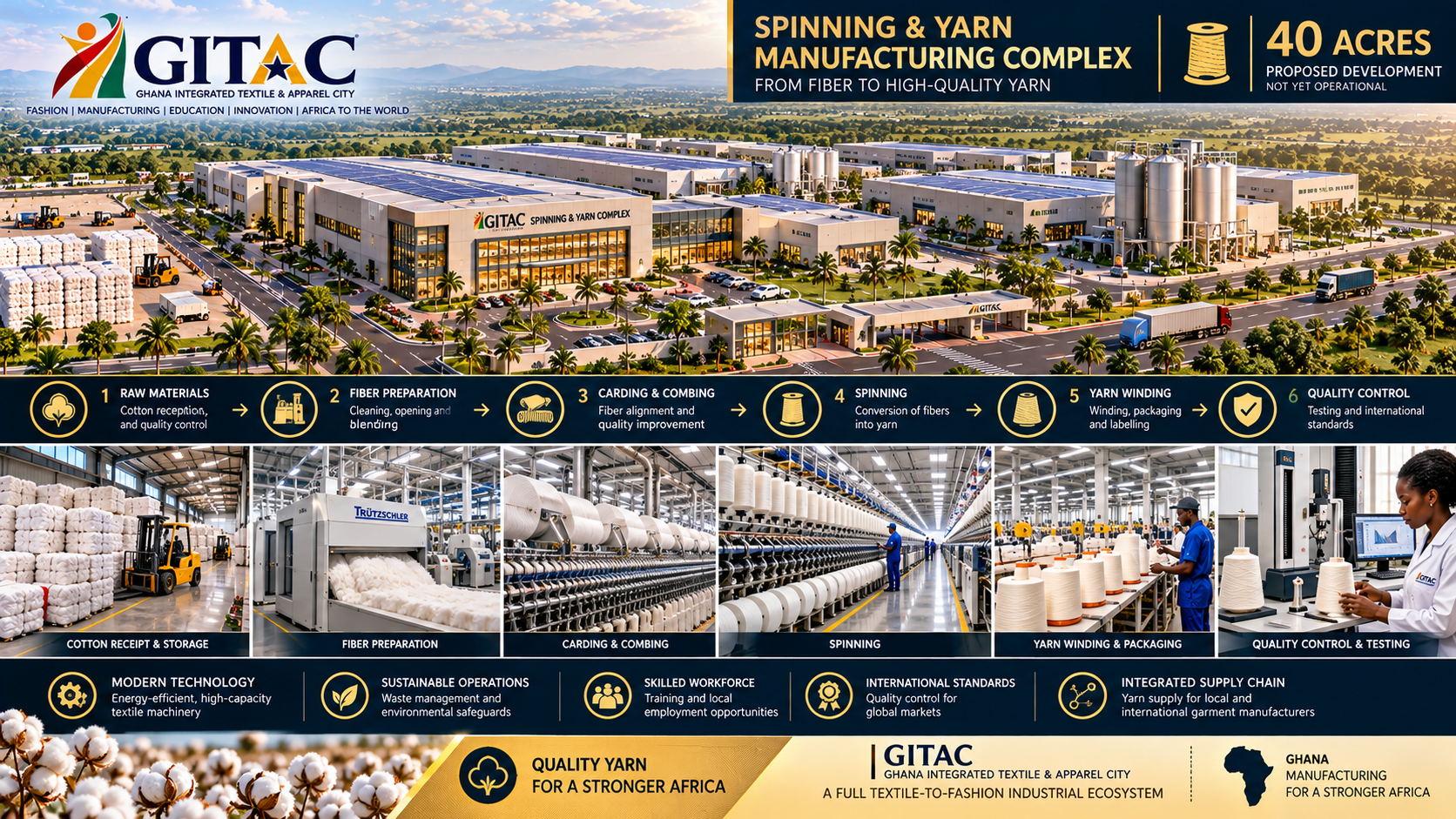
Spinning & Yarn Manufacturing Complex
The proposed GITAC Spinning & Yarn Manufacturing Complex is envisioned as a modern industrial production hub for converting cotton and other suitable textile fibers into high-quality yarn.
The complex is intended to accommodate fiber preparation, carding, combing, spinning, yarn winding, packaging, and quality-control operations.
Through partnerships with established textile manufacturers and technology providers, GITAC aims to support efficient yarn production, workforce skills development, and stronger supply-chain integration for Ghana's textile and apparel industry.
The facilities will be planned with consideration for energy efficiency, industrial safety, quality assurance, and international manufacturing requirements.
GITAC Spinning & Yarn Manufacturing Complex — Conceptual Visualization. Proposed development; not yet operational.
GITAC — Weaving & Knitting Manufacturing Complex
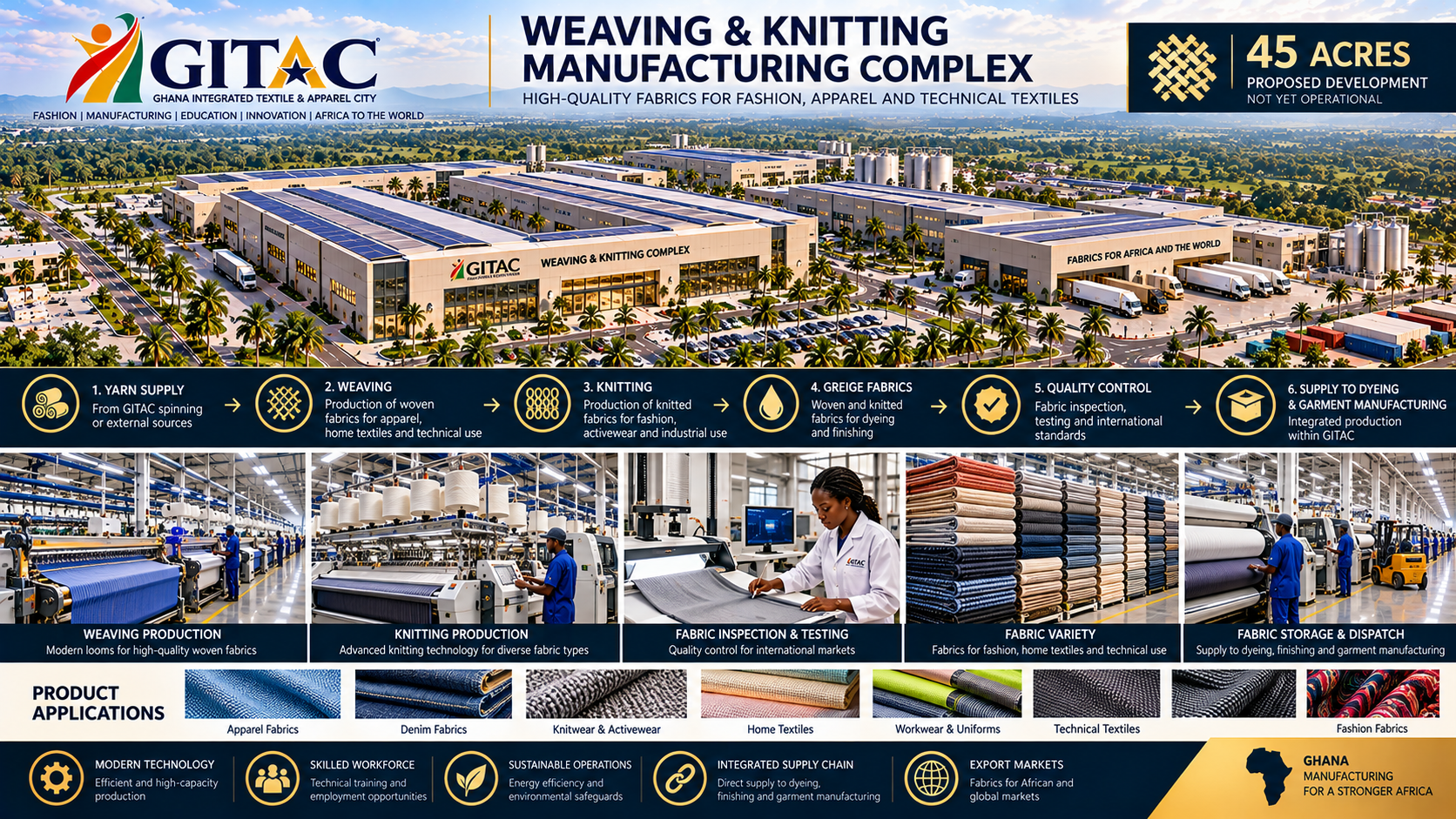
The proposed GITAC Weaving & Knitting Manufacturing Complex will form a central component of the integrated textile production ecosystem.
The complex is envisioned to accommodate modern weaving looms, circular and flat knitting machinery, fabric inspection systems, quality-control laboratories, and industrial storage facilities.
Through collaboration with established international textile manufacturers, GITAC aims to support the production of woven and knitted fabrics for fashion, apparel, uniforms, home textiles, and selected technical textile applications.
The development is intended to strengthen Ghana's textile supply chain, encourage technology transfer, expand skilled manufacturing employment, and support access to regional and international markets.
GITAC Weaving & Knitting Manufacturing Complex — Conceptual Visualization. Proposed development; not yet operational.
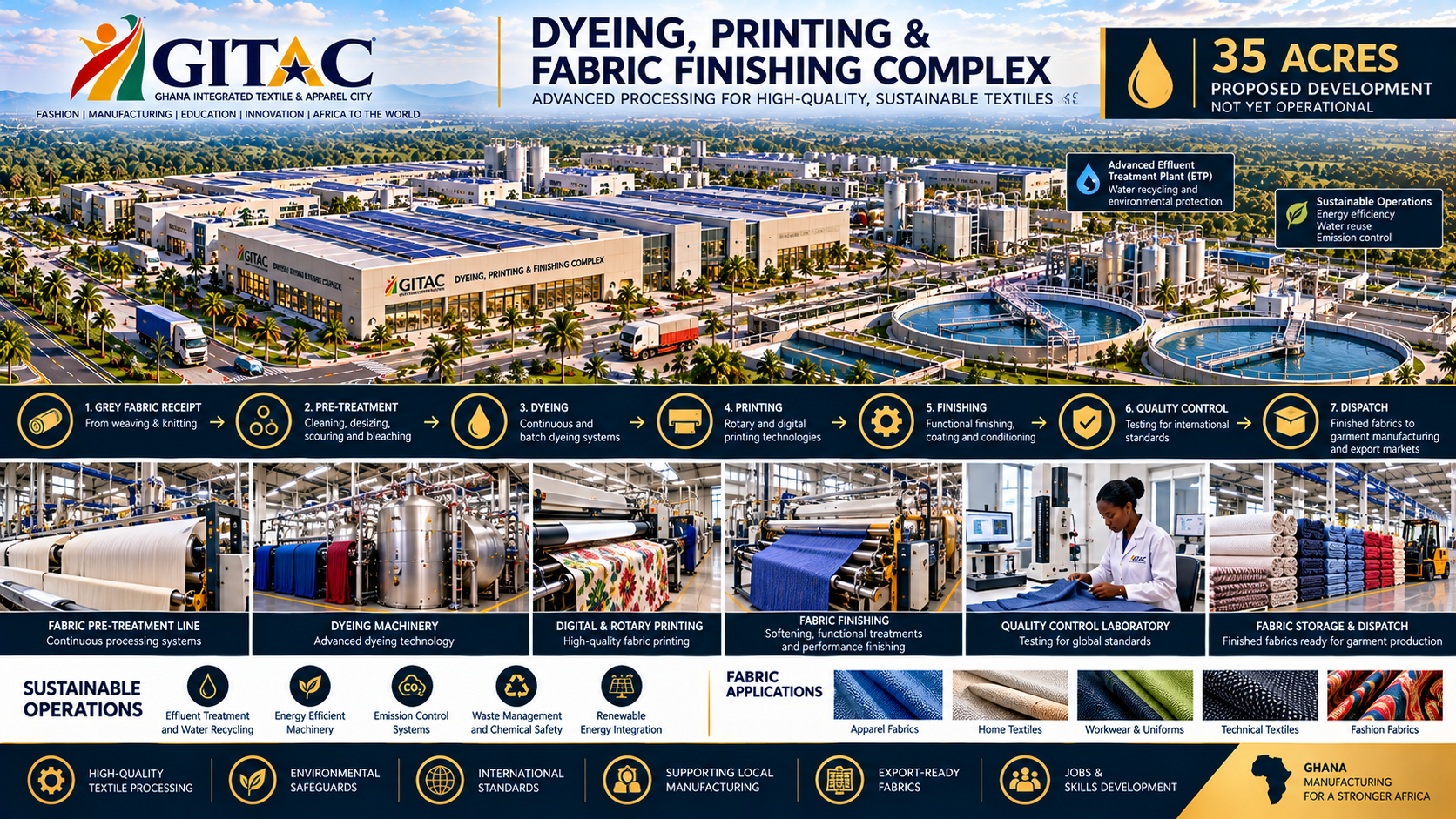
GITAC — Dyeing, Printing & Fabric Finishing Complex
The proposed GITAC Dyeing, Printing & Fabric Finishing Complex is envisioned as a specialized industrial facility supporting the transformation of unfinished textiles into high-quality fabrics for domestic and international markets.
The complex is planned to accommodate fabric preparation, dyeing, digital and rotary printing, finishing, quality testing, and associated industrial services.
Environmental responsibility will be a central planning consideration, including industrial wastewater treatment, water recycling, chemical management, energy efficiency, and pollution prevention.
Through collaboration with experienced textile manufacturers and technology partners, GITAC aims to support advanced textile processing capabilities, strengthen Ghana's manufacturing value chain, and promote internationally competitive fabric production.
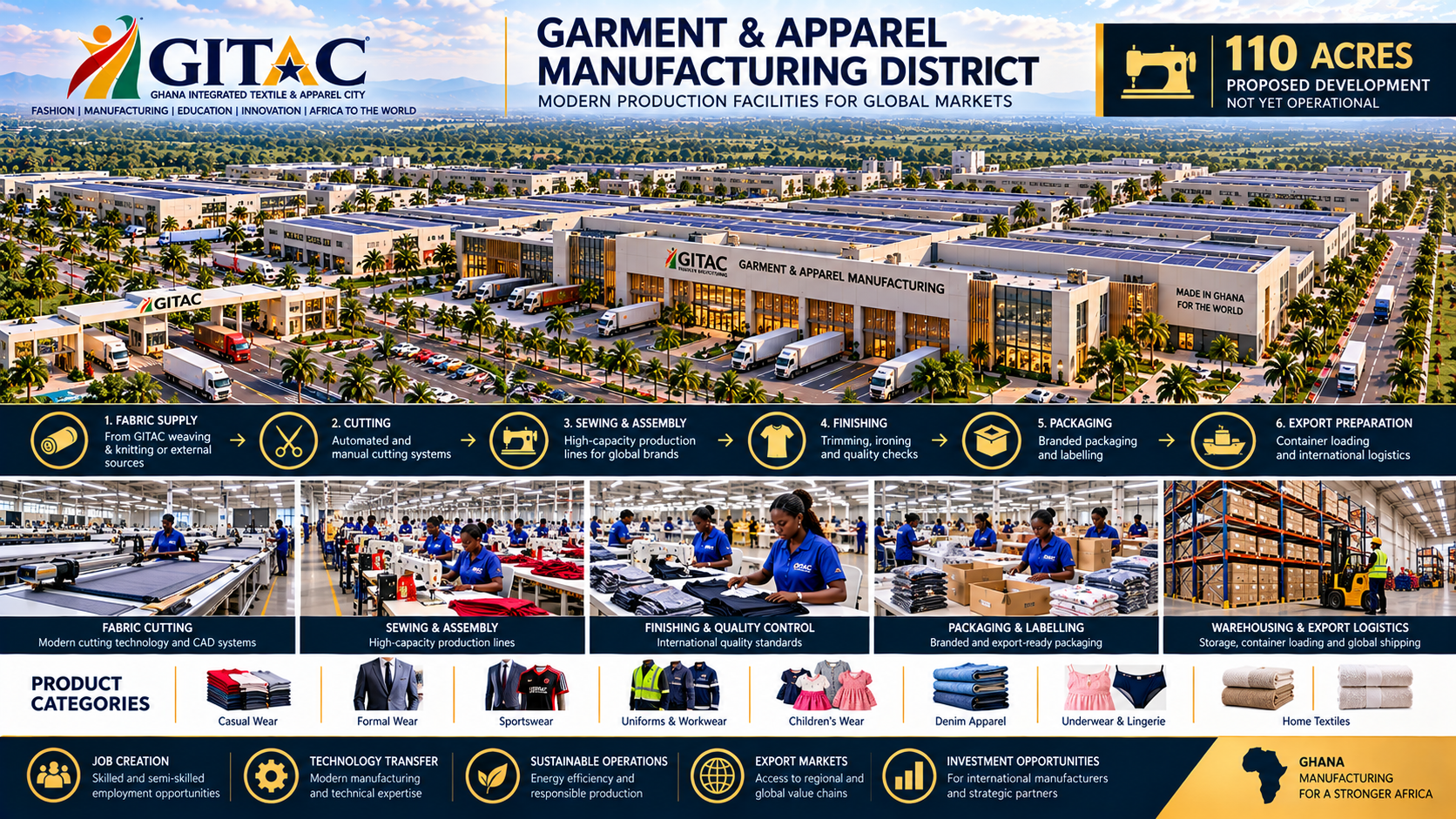
GITAC — Garment & Apparel Manufacturing District
The proposed GITAC Garment & Apparel Manufacturing District is envisioned as a major production hub accommodating domestic and international apparel manufacturers.
The district will be designed to support modern garment production, including fabric cutting, sewing, assembly, finishing, quality control, packaging, and export preparation.
GITAC aims to attract established manufacturers producing casualwear, formalwear, sportswear, uniforms, children's clothing, denim apparel, and other textile-based products.
Through purpose-built industrial facilities, workforce development, shared infrastructure, and international manufacturing partnerships, GITAC seeks to strengthen Ghana's apparel industry, create employment opportunities, encourage technology transfer, and improve access to regional and global markets.
The district may accommodate a combination of large-scale manufacturing facilities and smaller production units, subject to investor demand and detailed industrial planning.
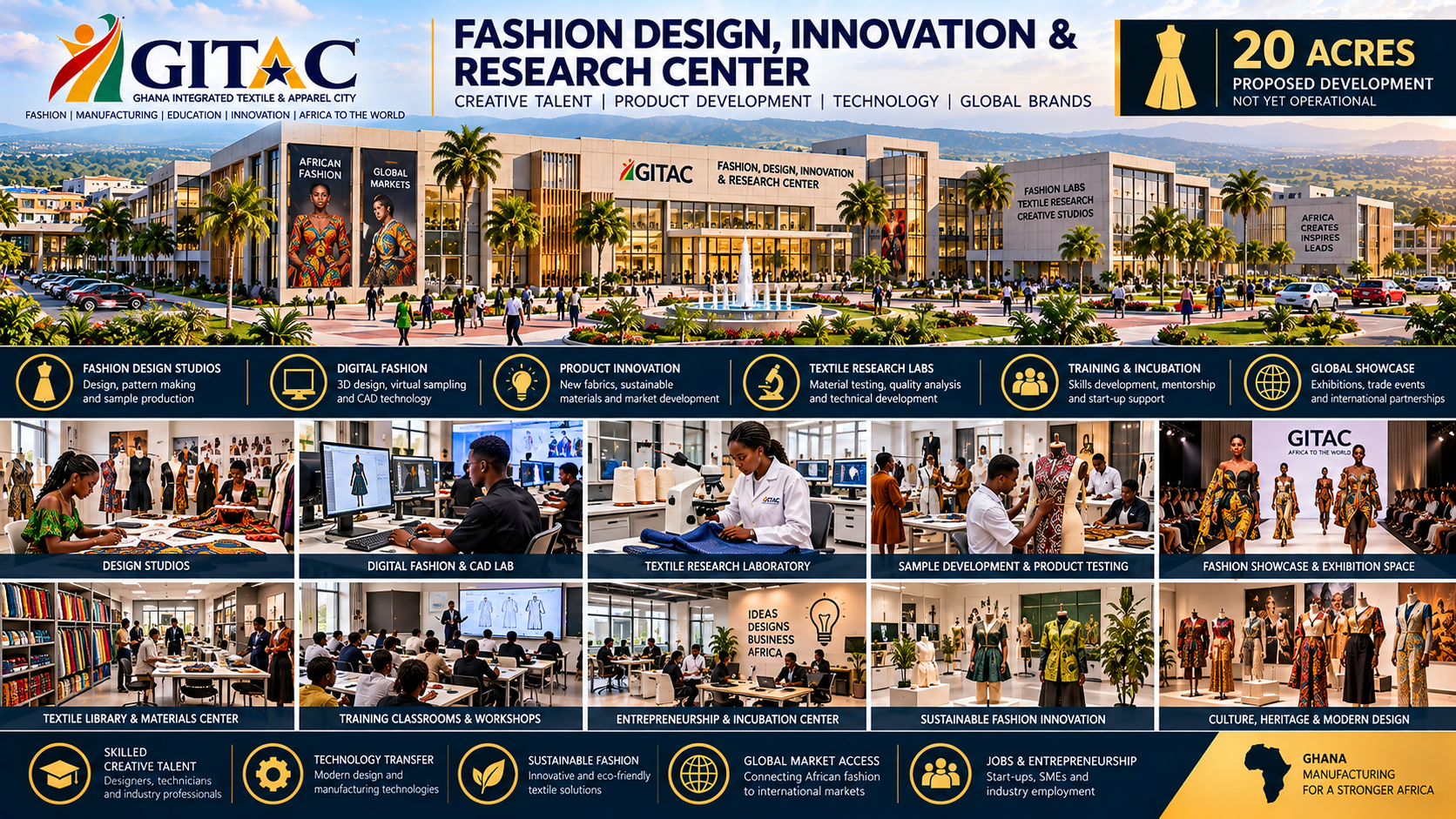
GITAC — Fashion Design, Innovation & Research Center
The proposed GITAC Fashion Design, Innovation & Research Center is envisioned as a hub for creativity, technology, product development, and applied textile research.
The center aims to bring together Ghanaian and international fashion designers, textile researchers, technology providers, educational institutions, and emerging fashion entrepreneurs.
Planned facilities may include professional design studios, digital fashion and CAD laboratories, textile testing facilities, product development workshops, fashion incubation spaces, and exhibition areas.
Through research collaboration, technology transfer, skills development, and industry partnerships, GITAC seeks to strengthen Ghana's fashion innovation capabilities and support the development of internationally competitive African fashion brands.
The center will also aim to encourage sustainable design practices, responsible material innovation, and the integration of Ghanaian creative heritage into contemporary fashion production.
GITAC Fashion Design, Innovation & Research Center — Conceptual Visualization. Proposed development; not yet operational.
GITAC — Textile & Apparel Technical Education and Skills Academy
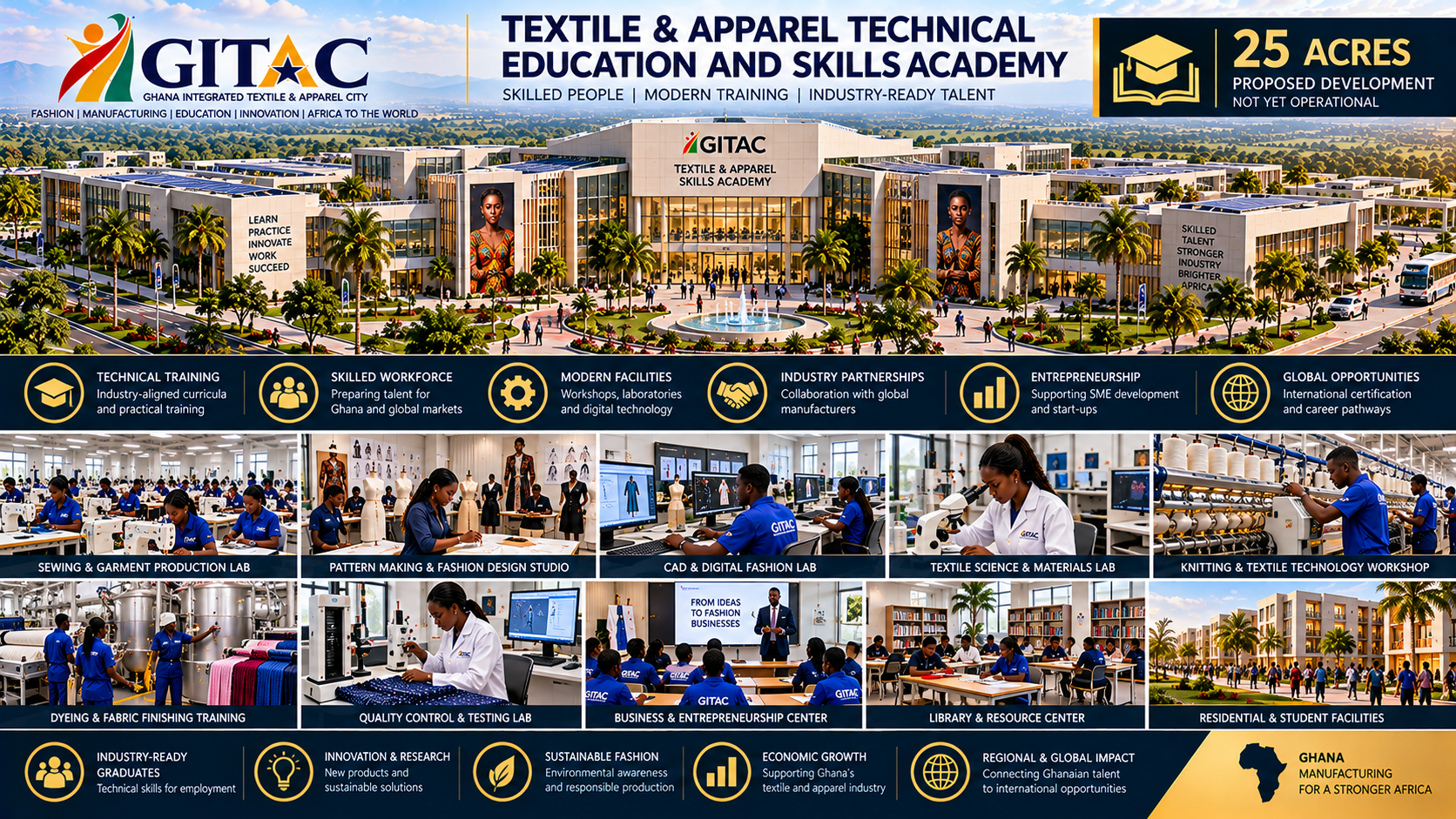
The proposed GITAC Textile & Apparel Technical Education and Skills Academy is envisioned as a specialized training institution dedicated to developing a skilled workforce for Ghana's textile, garment manufacturing, and fashion industries.
The academy aims to provide practical, industry-oriented training in garment production, industrial sewing, pattern making, textile technology, fabric processing, digital fashion design, quality control, and manufacturing operations.
Through potential collaborations with international manufacturers, technical institutions, vocational education providers, and industry experts, GITAC seeks to create training pathways that connect education directly with employment and entrepreneurship opportunities.
The proposed facilities may include industrial training workshops, sewing laboratories, textile engineering classrooms, digital design studios, research laboratories, entrepreneurship training spaces, and student support facilities.
The academy is intended to support Ghana's industrial development by strengthening technical skills, promoting technology transfer, and preparing graduates for careers in domestic and international textile and apparel manufacturing.
GITAC Textile & Apparel Technical Education and Skills Academy — Conceptual Visualization. Proposed development; not yet operational.
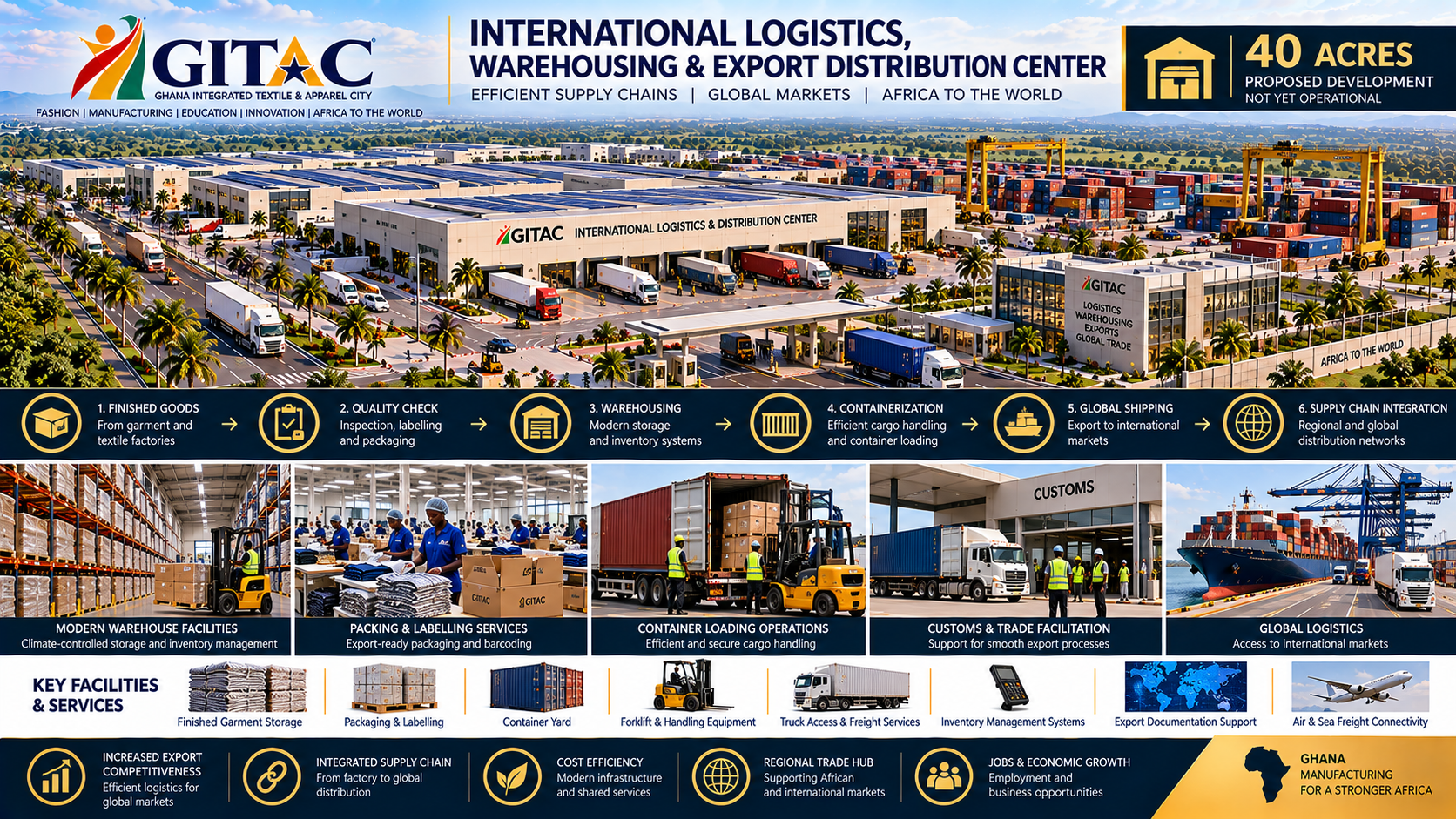
Integrated Solutions for Complex Needs
The proposed GITAC International Logistics, Warehousing & Export Distribution Center is envisioned as a central logistics hub supporting textile manufacturers, garment producers, international buyers, and regional distribution networks.
The center is intended to accommodate modern warehousing facilities, inventory management systems, packaging and labeling operations, freight coordination, container handling, and export documentation support.
By integrating manufacturing with logistics and distribution services, GITAC aims to improve supply-chain efficiency, facilitate international trade, and strengthen Ghana's position as a competitive textile and apparel manufacturing destination.
The proposed facilities will be planned to support domestic distribution, regional African markets, and international export operations through partnerships with established logistics providers, freight operators, and trade facilitation institutions.
GITAC International Logistics, Warehousing & Export Distribution Center — Conceptual Visualization. Proposed development; not yet operational.
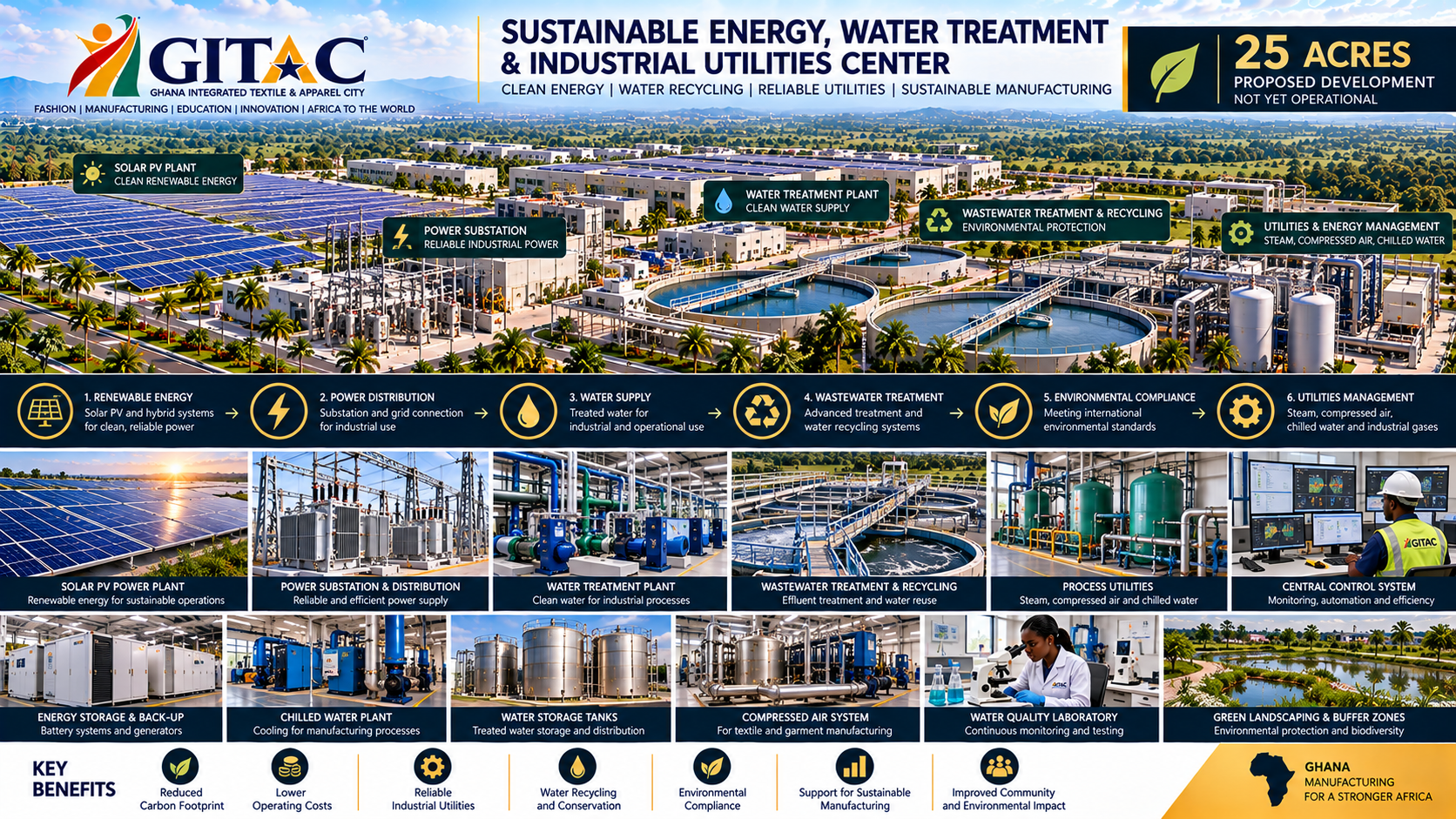
GITAC — Sustainable Energy, Water Treatment & Industrial Utilities Center
The proposed GITAC Sustainable Energy, Water Treatment & Industrial Utilities Center is envisioned as a shared infrastructure hub supporting reliable and environmentally responsible textile and apparel manufacturing.
The development is intended to incorporate industrial electricity distribution, potential solar energy generation, water supply and treatment systems, wastewater management, water recycling, and essential industrial utilities.
Special attention will be given to the infrastructure requirements of textile dyeing, printing, and fabric finishing, which can involve significant water consumption, energy demand, and wastewater treatment needs.
Through appropriate engineering design, environmental safeguards, and partnerships with experienced infrastructure providers, GITAC aims to support resource-efficient manufacturing, responsible industrial development, and long-term operational reliability.
The final infrastructure configuration, capacity, and technology choices will be determined through feasibility studies, environmental assessments, and detailed engineering.
GITAC Sustainable Energy, Water Treatment & Industrial Utilities Center — Conceptual Visualization. Proposed development; not yet operational.
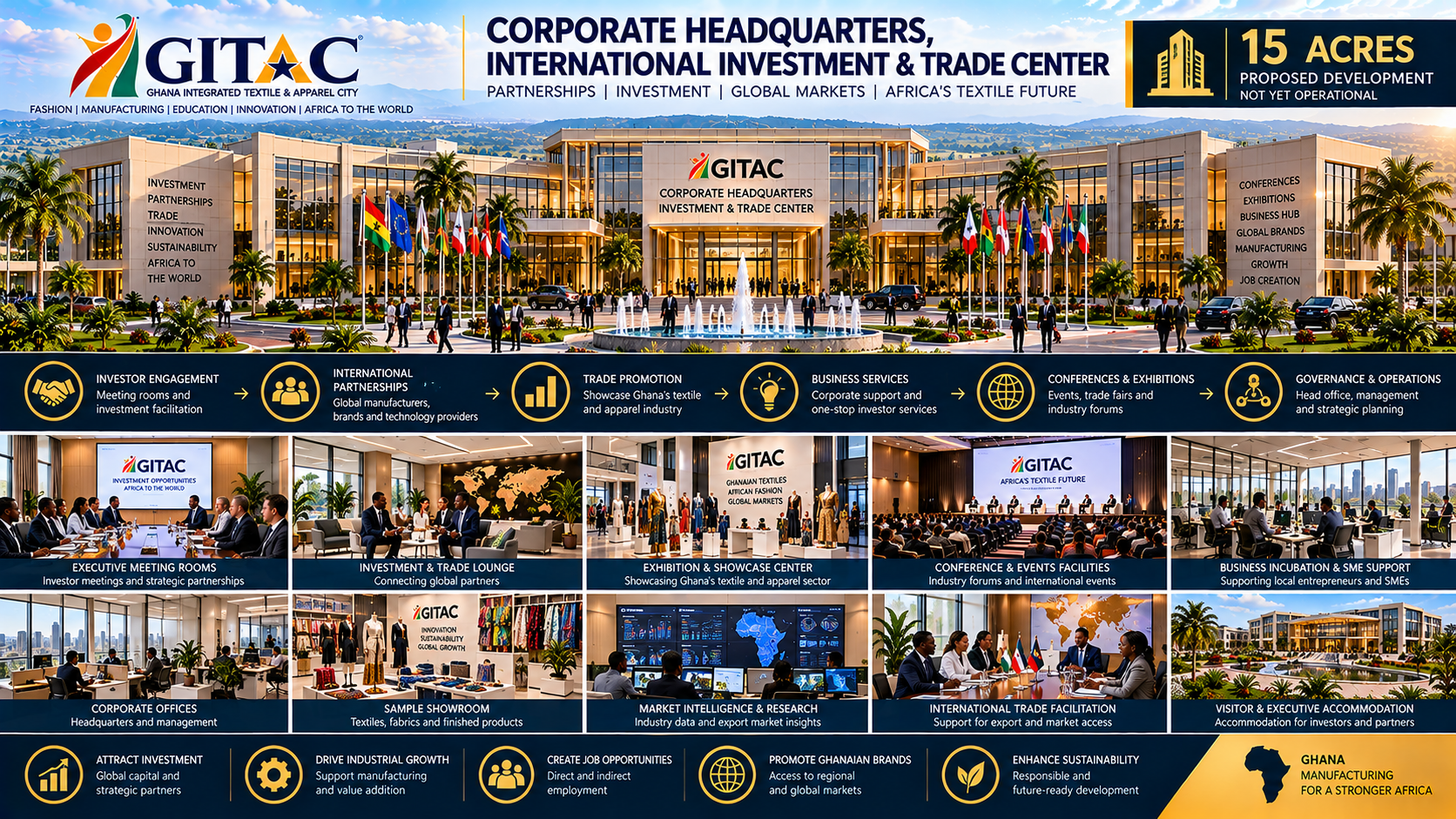
GITAC — Corporate Headquarters, International Investment & Trade Center
The proposed GITAC Corporate Headquarters, International Investment & Trade Center is envisioned as the strategic administrative and commercial coordination hub of Ghana Integrated Textile & Apparel City.
The center is intended to provide facilities for corporate administration, international investor engagement, manufacturing partnerships, trade promotion, business development, and industry collaboration.
Planned facilities may include executive offices, investor meeting suites, international conference rooms, textile and apparel showrooms, exhibition spaces, business support services, and dedicated areas for strategic partner engagement.
Through this proposed center, GITAC aims to create a professional environment connecting international manufacturers, financial institutions, technology providers, development partners, Ghanaian entrepreneurs, and global buyers.
The center is also envisioned to support investment facilitation, manufacturing opportunities, market intelligence, and international trade relationships that contribute to Ghana's long-term industrial development.
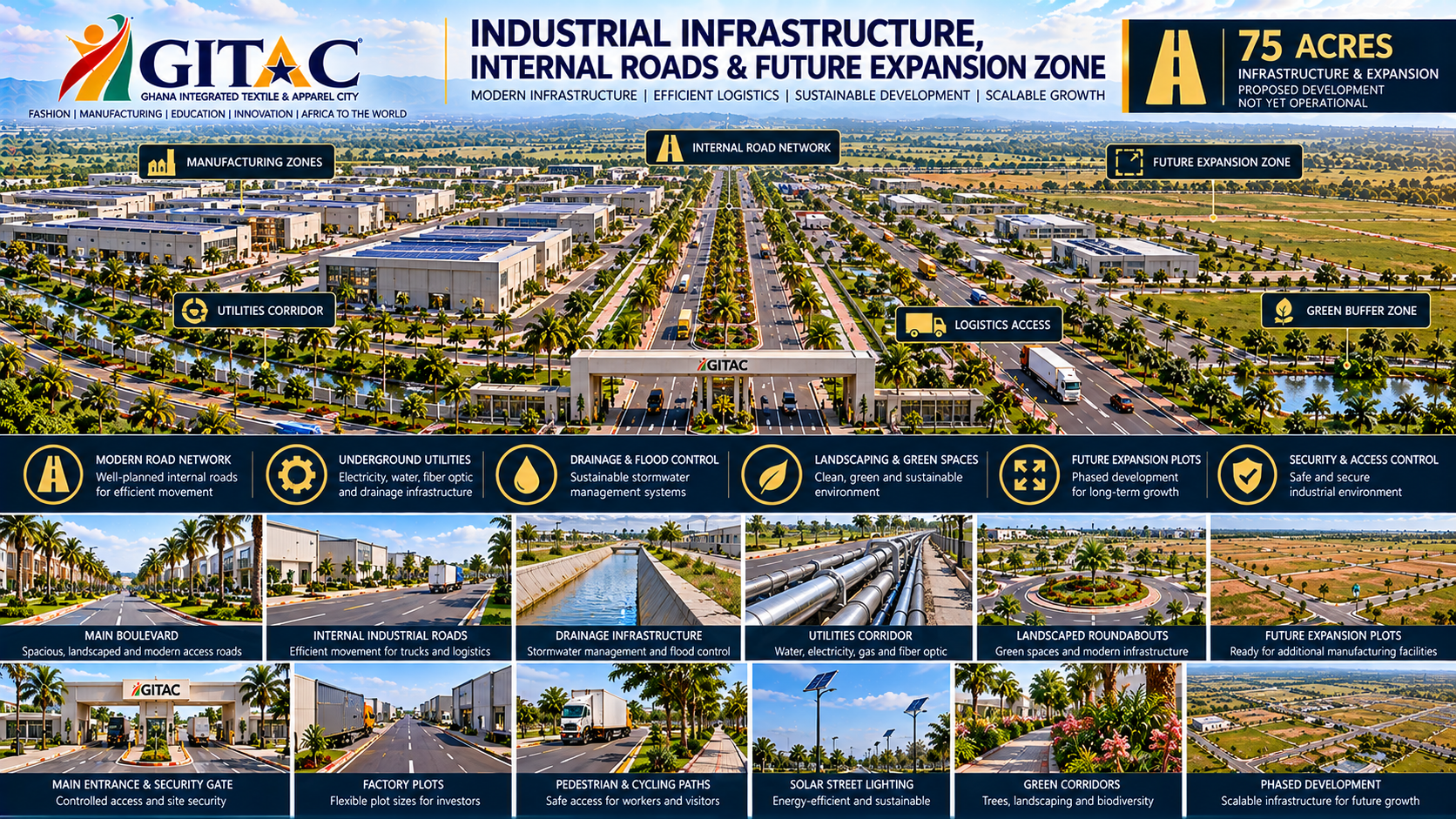
GITAC — Industrial Infrastructure, Internal Roads & Future Expansion Zone
Ghana Integrated Textile & Apparel City (GITAC) envisions a modern industrial environment supported by coordinated infrastructure, efficient transport networks, and long-term expansion opportunities.
The proposed development will incorporate internal industrial roads, designated freight routes, utility corridors, stormwater drainage systems, landscaped green spaces, pedestrian access, and industrial security infrastructure.
The master planning approach aims to provide flexible industrial plots capable of accommodating manufacturers of different sizes, while allowing infrastructure and production facilities to expand in response to investment demand.
GITAC intends to adopt a phased development strategy, prioritizing essential manufacturing infrastructure during the initial stages and progressively introducing additional industrial facilities, logistics services, and supporting amenities.
Detailed infrastructure requirements, road layouts, environmental safeguards, and expansion areas will be determined through technical feasibility studies and comprehensive master planning.